Sunday, 3 January 2016

Atul Gawande on End Of Life

 
One of the best current writers about End Of Life is Atul Gawande. He is a surgeon who has spent a lot of time keeping people alive. His thoughts on the terrible price to comfort, dignity and wellbeing of the past medical imperative to keep people alive at all costs are well worth reading, especially in his great book "Being Mortal".
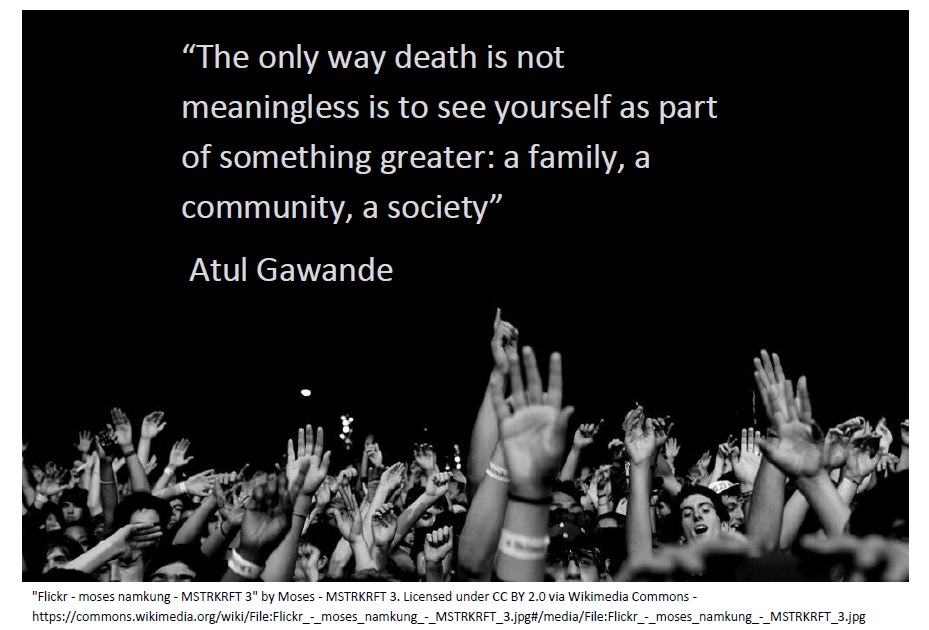
 
Atul Gawande poses 5 questions that are useful to anyone to people facing the end of their own lives, and the issues they will need to face, along with their families and carers.

These questions are:

1. What is your understanding of where you are and of your illness?

 2. Your fears or worries for the future

 3. Your goals and priorities

 4. What outcomes are unacceptable to you? What are you willing to sacrifice and not?

 And later,

 5. What would a good day look like?
I am struck by how similar these questions are to questions, tools and approaches routinely used in 'person centred practices', tools I learned in my own past practice from teachers I've met and worked with,  like Gill Bailey, Helen Sanderson, Michael Smull, John O'Brien.

We found the person centred questions we asked powerful, because they applied as much to ourselves as to the people we were thinking with. They are universal questions that apply to any human being. Of course they are particularly useful when faced with the challenge of a disease or disability, and when the unconscious social response to the presence of such conditions has been to take away choice and control from the person affected.

Thinking about questions like these are a way of winning back some choice and control, of working out what is important to you now and in the future and making sure that this happens, rather than being drowned in a sea of other pressing priorities.

A death where the dying person has won back some control over where and how they die, over who is with them, and crucially how they live well in a way that makes sense to them before they die, which has mindfully included what is important to them could be described as a 'person centred death'.

I've already done a little of this thinking for myself, and shared tools like my one page profile and my history map on this blog. My most recent scan suggests I need to think more urgently about Atul Gawande's questions and my recent time staying at St Catherine's hospice gave me a chance to think about this.

So I've been talking to my wife, who is currently also my main carer (though she doesn't recognise this as a description of her role!). We will be working through some of the tools in 'Living Well' a really good tool for end of life that was designed by people from Lancashire County Council as well as Helen Sanderson Associates. Some examples of them may well get posted on this blog!


I'm really going to have to give some thought to what matters to me. Most of this I'm realising is the people around me. My friends and family, so I'm going to need to think about good ways to spend time with them, and letting them know what they mean to me.


One of the major discussions we have been having has been about who our real circle of support comprises. So many different people have stepped forward in different ways to offer us support, including really valued friends who have cooked meals and been there for both me and my wife in a way that I think is unsurpassable. Phone calls and warm messages have reached me from all over the world, and I know that prayers have been said for me in places of worship of many different religions and denominations! One person has kindly given me access to time in her beautiful retreat space. At some point it will be useful to draw together this amazing circle and think with them about the support I'll need at end of life. I hope to get some help with this from Community Circles.
We've spoken about where I would like to die. My wife and step-daughter both felt really strongly I should die at home. I've been thinking about this. When our son was born at home, I realised how small our terraced house was, particularly with extra midwives, breathing equipment and all the accoutrements of birth packed in. Supporting someone to die must have interesting similarities to helping someone be born. I can see that it will involve  a lot of work and disruption for my wife and famly. I also think however with a good circle of support around them it could work and be exactly the kind of death that would make sense for me. I know that when it comes to it, the people I love can help me have a good life right up to my death, and then a dignified death with the people that really matter to me around me, the people who have been my community and who have given my life meaning.
These are the things I'll be putting into my end of life plan. As Atul Gawande said “You may not control life's circumstances, but getting to be the author of your life means getting to control what you do with them.”


Tuesday, 29 December 2015

Christmas in the Hospice

I didn't expect to be waking up on Christmas morning in a hospice.

But my life's like that now. The results of one scan can throw all my plans up in the air.
And the results of my last scan weren't the best I could have hoped for.

I'm far from dying yet though. I got offered the place here at St Catherines so that I could get on top of my pain.

I've been taking the wrong attitude to my pain. I've stoically tried to tough it through during the day, leaving me knackered at night. This approach has meant that I simply haven't left myself open to the joys that life can offer. Most nights I've ended up frantic as the pain bites in: no good for me, and no good for my wife who gets disturbed every time.

So over some time here, with the help of the nurses and medics my meds are being adjusted, and I'm finding out that stuff I didn't think worked does work, as well as how to space it, how to be less anxious about it.
"Juletræslys". Licensed under CC BY-SA 3.0 via Wikimedia Commons - https://commons.wikimedia.org/wiki/File:Juletr%C3%A6slys.jpg#/media/File:Juletr%C3%A6slys.jpg


And being here has also given me a chance to talk to friends and family about the reality of my illness. I think maybe I tend try to protect people from my bad news. This hasn't done them any favours, and I've been told off about it! The word 'hospice' on the front door means there can't be any pretence. I have a pretty aggressive cancer. It's not behaving like a normal bowel cancer. Even with the very best chemotherapy my chances are maybe one in twenty.

Of course his doesn't mean I've no chance. I know people who've survived worse odds. I'm hoping to get onto a clinical trial, and will work with Christie if any become available. The lads play Dungeons and Dragons. They know how hard it is to roll a 20 with a 20 sided dice!

Christmas was lovely here.

It is a privilege to wake up among the dying. It is a privilege to be cared for by dedicated people, including volunteers who have come in over Christmas and the 'dog end' days of the year to support the people here. When the news is so packed tight with inhumanity, it is a true privilege to see countless small acts of humanity happening, in the very darkest times of the early morning, in the warmth of the cleaner's voice as she moves from room to room, in the humour and stories of the nurses and helpers.

As I'm writing, a lovely lady has come in. She takes all the flowers donated to St Catherines' and turns them into beautiful smaller arrangements that she leaves in every room. Every few days she comes back to refresh or replace them, she has been doing it for years and nothing seems to stop her. Humanity expressed through her artistry and persistence.

Years ago I read a great book by Boykin and Schoenhofner that seems to be a well kept secret. It's called 'Nursing as Caring' and it's always stuck in my mind far more than the technocratic rather mechanical ways of theorising nursing care.

I think the future study of great care, the understanding of what really makes good person centred support for people will actually be an inquiry into our own humanity and how to use it effectively for people. I'm witnessing that when a caring organisation enables everyone in it to find ways to express their humanity, to listen to people and deliver what is important to them, it becomes a true House of Care, a genuinely nurturing environment very different from some of the toxic institutions we seem to create so easily. It's too easy to sacrifice our own humanity in the name of  'professionalism' or for countless other persuasive reasons.

The Christmas tree in the chapel here is incredibly beautiful. Children have cut out paper angels, and written messages to hang on the tree for their parents who died here: "I hope heaven is special mummy".

I managed to spend time out at home over Christmas too, and had great family meals on Christmas Eve and Christmas day, great fun playing Articulate! I think the plan is for me to spend a few more days here, then to get home. I'm going to use that time to do some writing. Isabel Allende said "Write what should not be forgotten".  I'm hoping to write some very personal and private stuff for my family and build it into some kind of personal cancer journal that includes some of the person centred thinking tools like my life story, my hopes and fears and a few things I'd like to do. I don't have many big 'bucket list' ambitions. A trip to Disneyland would be my idea of a nightmare!

I do intend to go to watch the great poet John Cooper Clarke when he appears in Preston, I saw him a few times 30 years ago. He would be the highlight of  CND demos in Manchester bringing his cutting cynical humour dispensed in economical rhyme as a great counterpoint to the interminable speeches of the assorted politicians! He's no stranger to death among his friends himself at the moment: "I could go to five funerals a week. But that many vol au vents isn't good for you"
Time with family. Time with the people special to me. That's what I'm focussing on right now.


Friday, 2 October 2015

Facts and Figures on bowel cancer in Lancashire.

If you're looking for facts and figures about the prevalence of bowel cancer in Lancashire, or about survival rates, or how Lancashire compares with the rest of the country, then this is the document for you. http://www3.lancashire.gov.uk/corporate/web/viewdoc.asp?id=120935

Friday, 18 September 2015

One Year Since Diagnosis

On 19th September it will be a year to the day from when I was first diagnosed with a cancer.
It's also about 4 months since the scan that showed that my cancer has metastasised, where I moved up to Level 4 and those words 'incurable' and 'terminal' began to apply to me.

As you can imagine it's been a year of immense learning.
I've learned a lot about cancer.
I've learned a lot about myself.
I've learned a lot about the warmth of people, and what friendship and family really means.

I remember the confusion I felt on the first night I spent on the Surgical ward. Apart from the aches that had taken me to the GP's that evening, I felt pretty well. Everyone else on the ward looked to be in terrible distress. All round me were people vomiting green bile, people clearly in agony. I felt like an intruder.

It's a feeling I still have a lot of the time, because apart from pain, my operation scars and my stoma, there's nothing tangible that tells me I have cancer.

In the last few weeks a lot of things have been falling into place. I've moved off codeine, which I really disliked because it made me twitchy and anxious, onto morphine, which is controlling my pain much better. I have a MacMillan nurse who is giving me good advice around pain. I'll be discussing end of life planning with her next week. I'm working things out so that I can keep on at work.

I have had a scan that shows that while the nodules are still growing, the rate of growth has been considerably slowed down by the chemo. I would have hoped for shrinkage, but I'm told very slow growth is almost as good.

I've also read Serwan-Schreiber's book 'Anti-Cancer'. This has inspired me to take diet and exercise much more seriously. According to the stats I've read, 12 out of every 100 men with bowel cancer that has metastasised are still alive five years after diagnosis. I have every intention of being one of those 12, but I also need to plan in case I'm one of the 88. Eating well, including things like turmeric, ginger, garlic, fresh fruit, vegetables and green tea in my diet has already improved how well I feel, and I'm certainly enjoying the taste of my food more than when I was following the advice of the stoma nurses to 'eat plenty of stodge'.

Last Saturday I attended Preston's 'Gentle Approach to Cancer' group, and enjoyed my first ever yoga session, which was also the first formal set of exercises I've participated in since my operation. Moving in this way, even once has boosted my physical confidence and made me feel better in my own body. It was great to meet people who are living with cancer, to hear their stories and basically be with people I don't need to explain everything to. We sung the song I've posted in the photo together. In general I find great support from groups of people with experience of cancer in their own lives, like this group, and like the online forums that exist. Nothing beats lived experience.

I also want to plug my mate Ben Ashworth. He has bowel cancer too, lives round the corner from me and has run 17 marathons in 17 months. He is raising enormous sums for charities. He's a personal hero of mine. He's been living the bowel cancer adventure for about a year longer than me, and is just a wonderful individual.

My message to people newly prescribed with a cancer, or who have just discovered that their cancer has metastasised is "don't panic". Keep going. Find strength in other people, particularly people who are living with cancer themselves. Find little ways to win more control. Take one day at a time, days turn into weeks, weeks turn into years.

The survival stats for men with a Level 4 metastatic bowel cancer don't look brilliant. Something like 7 in every 100 live for more than 5 years. One question to ask is "why shouldn't I be one of those 7?" another is "What do I need to do so that I have a good life for as long as I can, what do I need to do to make sure my family are OK in case I am one of the 93?"

Friday, 29 May 2015

Using Life History To Think About the Past and Prepare for the Future

This was originally posted here: http://connect4life.blogspot.co.uk/2015/05/life-history-and-long-term-conditions.html


When I got the bad news that I had a diagnosis of an advanced bowel cancer, even though I had had 6 months following my operation to prepare, it still took me a while to get my head around the idea. I doubt if I've still fully processed it, or properly discussed it with everyone that matters to me, but I'm doing my best to get on with this.

Getting a serious diagnosis is definitely a time that many of us start to think about what really matters to us. Who we are, what our wishes, hopes and fears are.

Person Centred Thinking offers a set of tools and questions that help us with this. Using them to think with the people we love, and the people who know us best helps us have those important conversations.

I recently posted my One Page Profile here which is one example of person centred thinking. I've now shared it with my Oncologist who said she would find it really useful as a way of helping her understand my wishes. She has photocopied it to share with the whole Multi-Disciplinary Team involved in my care. I'll be sharing it on my visits to the Rosemere for chemo, and with the District Nurses who will be looking after my PICC line and taking down my bolus pump and syringe.

Another tool that helps with this kind of thinking is the 'History and Important Memories' Timeline. I found it in the 'Living Well' document developed by Lancashire County Council with Helen Sanderson Associates. They designed the pack as a way to help people and their families being supported in palliative and end of life care. I've begun to fill it in, and I'm including an example of an early draft here. There is still loads of important detail to include!

One of the most difficult things about having an advanced  cancer is the uncertainty. If you ask your oncologist 'How long have I got then?', they have no way of giving you an answer. I'm starting a course of chemotherapy that might cause the secondary cancers to disappear, shrink, stand still or simply not be effective. It's impossible to say until it happens. If it doesn't work then I hope there's something else to try up her sleeve! I'm meeting people who have walked around with a cancer for 10 years, managing it with chemo, others who have seen their cancers become very aggressive, others whose cancers have gone into remission for no apparent reason. I could become any of these people.

Stepping back to think about your past is one way to prepare for an uncertain future, and that's how I'm using this 'history' tool. I'm at an early stage, but I'm gradually adding in more and more important events, places and people from my past.

Filling it in has made me think about some of the formative events and experiences that helped me establish my values as well as the joyful times I've spent with the people that matter to me most.

It has also made me think about the future quite differently. A few months ago I might have expected the end of the arrow to look like "cancer metastasises - pain and suffering - death".
Instead mine shows " back to work - cancer metastasises - camping trip, holiday in Venice - more chemo".

I'm already using this different perspective to work with my managers to put together a plan for how I can continue working and avoid major risks while having chemo. I'll also use it to help me prepare my family for some of the tough times and possibilities ahead. I'm learning to say "I have advanced bowel cancer, I'm managing it with chemo and the help of my family, colleagues, friends and the people at the Rosemere unit".

I'll be working through more of these tools, and sharing them as part of my work with Connect 4 Life. I feel my past experience as a trainer in the world of person centred planning puts me in a position where I can help both service providers and people living with long term health conditions see some of the potential in these tools as a way of regaining some control in life in times that are unpredictable, when it's too easy for others to take over. I'm hoping that by sharing tools like this, I can help services and family carers help many other people facing similar health issues win more control in the direction of their lives and support.

Thursday, 7 May 2015

My Bowel Cancer One Page Profile:

This was originally posted on the Connect4Life blog: http://connect4life.blogspot.co.uk/2015/05/one-page-profiles-for-long-term.html: thought I would share it here too!

One page profiles are a simple way that people with long term health conditions can tell our story and express our preferences.
They have a starkly simple format: They have just 3 questions:
  • What people like and admire about me.
  • What is important to me
  • How to support me well.
Max Neill, who works with Connect4Life as a community connector has just written a one page profile to share with his family, friends, workmates and health professionals involved in supporting him with his cancer.

He said "Last September I was diagnosed with bowel cancer and had an emergency operation followed by precautionary chemotherapy. In the last few weeks a scan revealed that despite the chemo, the cancer has metastasised, with new growths on my peritoneum and lymph. Obviously this means that I have a lot further to go on my cancer journey, but as well as being a cancer patient, I'm also a family man, a Connect4Life worker and someone who enjoys a game of Dungeons and Dragons!"

"I decided to write a one page profile for a few reasons. I thought it would be a good way to gather my thoughts together at a stressful time and express my wishes clearly. I'm going to see my oncologist again next week to discuss my options, and I wanted her to know that I want to do what I can to work towards a cure. I'll share it with people like my ostomy nurse and the district nurses who've been supporting me with my chemo, and the staff at the Rosemere Unit."

"I'm hoping that it will be a way to avoid having to answer the same questions over and over again!
I like the one page profile because it is so simple, yet it enables you to say so much. It avoids all the medical jargon, and it helps you have the important conversations you need to have at a time like this, both while you're making it, and while you're sharing it."

"It's too easy in a big busy healthcare system for your identity to be subsumed by your diagnosis. I want to use my one page profile so that who I am comes off the page, and I'm recognised as a person with my own priorities and my own hopes and fears. I think a tool like this would be useful to so many people, why shouldn't every cancer patient be helped to write a One Page Profile?"


You can find out more about One Page Profiles by following the links below:

This is a blog with one hundred examples of One Page Profiles being used in many different ways:
https://onepageprofiles.wordpress.com/

Here's a blog advocating the use of One Page Profiles with Older People living with cancer: http://opaalcopa.org.uk/tag/one-page-profiles/

Here's Amanda's One Page Profile written around her breast cancer: http://thinkaboutyourlifeandhealth.com/2013/06/28/using-one-page-profiles-to-direct-cancer-support-amandas-story/

The Learning Community for Person Centred Practices have shared many examples of One Page Profiles: http://www.learningcommunity.us/onepageprofiles.htm

Here's a blog showing how One Page Profiles can be used in personalising health services:
http://personalisinghealth.com/tag/one-page-profiles/

Think About Your Life offers a whole range of thinking resources to people living with cancer, including a template for a One Page Profile: http://www.thinkaboutyourlife.org/

You can also get in touch with Connect4Life!

Follow us on twitter: @C4LifeLancs

'Like' us on facebook: https://www.facebook.com/Connect4LifeLancs

Friday, 13 February 2015

Mindfulness and Chemotherapy

I've only really been practising mindfulness for a very short time. I'm just a beginner, but it is very useful to me.

It began last September when I picked up a leaflet about the Vajravarahi Centre in Preston, seeing that they did a free half hour relaxation session on Friday afternoons.

I was worried about how tired I was feeling all the time, and about my various aches and pains, so I felt it might help.

I ventured in, greeted by an enormous statue of the Buddha facing the doorway. I was directed to the meditation room, where we removed our shoes before entering. This is a beautiful room, decorated with some amazing statues. I was pleased to see everyone was sitting in ordinary chairs, rather than having to sit cross legged on the floor!

As I attended these sessions, I learned a few very simple techniques: relaxing the body, focussing on the breath, visualising problems and intrusive thoughts as black smoke being exhaled from the body, visualising a ball of nourishing white light that can be breathed into the body, and shifting the seat of consciousness from the head back into the heart.

The session was followed by tea, the chance to eat a vegetarian meal and have a chat.

In between the first time I attended and the second time, I was diagnosed with bowel cancer, admitted to hospital, had an operation to remove the tumour and create an ileostomy. After I was discharged from hospital, having this session to attend became a motivation to get out of the house, an opportunity to meet people and I had an inkling that what I was learning would be useful to me.

Sure enough it was.

Although the operation had removed all the tumour and there was no sign of any metastasis, I was put on 12 cycles of precautionary chemotherapy. In preparation for this, I had to have a 'PICC line' inserted, this is a thin plastic tube that is pushed up a vein in the arm, till it almost reaches the heart, so it can deliver the chemotherapy drugs directly into the body. Once it's inserted it lasts for the full course of the treatment.

Thinking about a plastic tube being pushed up your vein toward your heart is a fairly alarming and intrusive thought, and the process of insertion causes some discomfort. I used the technique of focussing on my breathing as a way of keeping control, and found that it worked well. I was able to get myself into a zone of relaxation and calmness as the procedure was carried out.

The first time I had chemo, the PICC line didn't work; it had a tiny hole that the chemo fluids leaked out of, so the line was pulled back out, and I was back in to have it reinserted the next day. The nurses remembered how I'd coped last time and encouraged me to use the same techniques again. I found these techniques worked even better the second time round. Since then I've had no trouble with my line.

Every fortnight I spend a day at the Rosemere Unit in Preston getting chemo. I've used the 3 hours I spend attached to a chemo drip as a chance to practice mindfulness.

On my 8th session, this Tuesday, something different happened. As the oxaliplatin was introduced, I sneezed a couple of times, then felt my scalp itching. Next minute it felt as if my scalp was on fire, the palms of my hands turned bright red, and red blotches and an itchy rash came up all over my arms and belly. My chest tightened painfully. It felt as if someone was sitting on me!

I was having an anaphylactic reaction to the medication. It's where the body's immune system runs out of control. I knew this can be potentially life threatening. I also knew I was in the safest place to be having such a reaction. Literally within seconds of the symptoms showing, the nurses and a medic seemed to appear from nowhere, they had surrounded me, stopped the oxaliplatin, were giving me hydrocortisone, paracetamol and piriton, checking my blood pressure and breathing and hooked me up to a heart monitor.

As this was happening I remembered the technique of shifting the seat of consciousness back toward the heart. This was a safe place for me to be, where I could observe what was happening to my body and around me, calmly, without panicking. I think a combination of using this technique and the calm competence of the team around me, particularly the way the young oncologist took charge meant that I never felt in any real danger. The drugs worked quickly, the pain subsided and the blotches began disappearing rapidly. Within 20 to 30 minutes I was back to normal. The team remarked on how calm I had been throughout.

As well as helping me through those painful and potentially alarming moments, I think practising mindfulness has had other effects useful in my everyday life, particularly in how I interact with my family and other people.

I don't do mindfulness as regularly as I should. I only go to the half hour sessions, rather than the longer ones in the evenings and at weekends, I don't think I do it particularly well. I'm easily distracted, my mind wanders everywhere, I fidget. I feel like I'm at the stage of someone learning to sail a model boat on a pond, rather than the captain of an ocean going liner. Nevertheless, learning a few simple mindfulness and relaxation techniques is helping me cope with a cancer, an operation, an ileostomy and the side effects of chemotherapy, as well as many other aspects of my life.

You can't knock it if it works!