Showing posts with label Choice. Show all posts

Saturday, 3 August 2013

What is The Learning Community for Person Centred Practices?

Readers of this blog will know that I travelled to Portland recently to participate in a gathering of the Learning Community for Person Centred Practices. I met a wonderful warm group of people who were welcoming and friendly, and who were facing the same challenges that we face in Britain.

After this, I had the great honour of participating in the community's board meeting that took place on the evening after the gathering and on the following day. It was great to sit among people whose work I've studied, and experience the personalities behind the words.

If I was to sum up in one sentence what the Learning Community was about, I'd say it was a place that people who are committed to person centred change, who want to see positive choice and control returned to the lives of people who have had it taken away by impersonal institutions and health and social care systems, can come together to share learning, gain mutual support and promote the very best practices.

The community is based in years of experience of implementing what became 'Essential Lifestyle Planning', and its deconstruction into 'Person Centred Thinking' and 'Person Centred Practices' whose directness, simplicity and practicality opened up person centred approaches to many more people. A key part of its work is gathering together what's being learned about what works and doesn't work in implementing such work, finding out what's most effective at creating positive change in people's lives and inclusion and contribution to their communities.

The learning community is International, being organised in a number of countries, including the USA, Canada, Australia, Britain and now India, and with many connections developing in other countries (I may have missed several out through sheer ignorance).

One of the key dangers person centred practices face is the misuse and perversion of it's language and techniques. All it takes for an organisation to claim it is 'person centred' is to stick this on their website. However organisations and individuals that take the challenge of increasing choice and control in people's lives seriously go far further, working hard with accredited trainers for deep cultural change in their organisations. Person Centredness is a journey on which many have embarked but where nobody has yet 'arrived', it's something we're striving for. TLCPCP therefore has an important role as the guardian of key values and practices that might otherwise be diluted or used as window dressing for what remain institutional and service-centred practices, particularly in a time of austerity where cheap shortcuts look so attractive to those that hold the purse-strings! (In the long, and not-so long run, such short cuts of course usually prove to be very expensive to all involved!)

The TLCPCP helps with this work by ensuring that trainers are accredited, and by renewing commitment and fidelity to the values that motivate person centred change. This is coupled with sharing very practical person centred thinking tools and skills that enable such change at scale. The crucial balance between fidelity to values and work at scale is at the heart of almost every discussion and debate held within the TLCPCP.

Given that TLCPCP is a non-profit organisation with no staff and very limited resources, it has achieved a great deal thanks to the commitment of its members and the warm support of partner organisations. It has aims to expand into new countries and further develop the evidence base for person centred practices, spreading them further and deeper so that choice and control can no longer be usurped from human beings by the systems intended to support them.

The TLCPCP has a lively facebook page and can be followed on twitter: @TLCPCP

Saturday, 27 July 2013

Portland Gathering 2013 Thursday: Connecting with the Community

Ideas about inclusion and community living
 
World Café Graphic

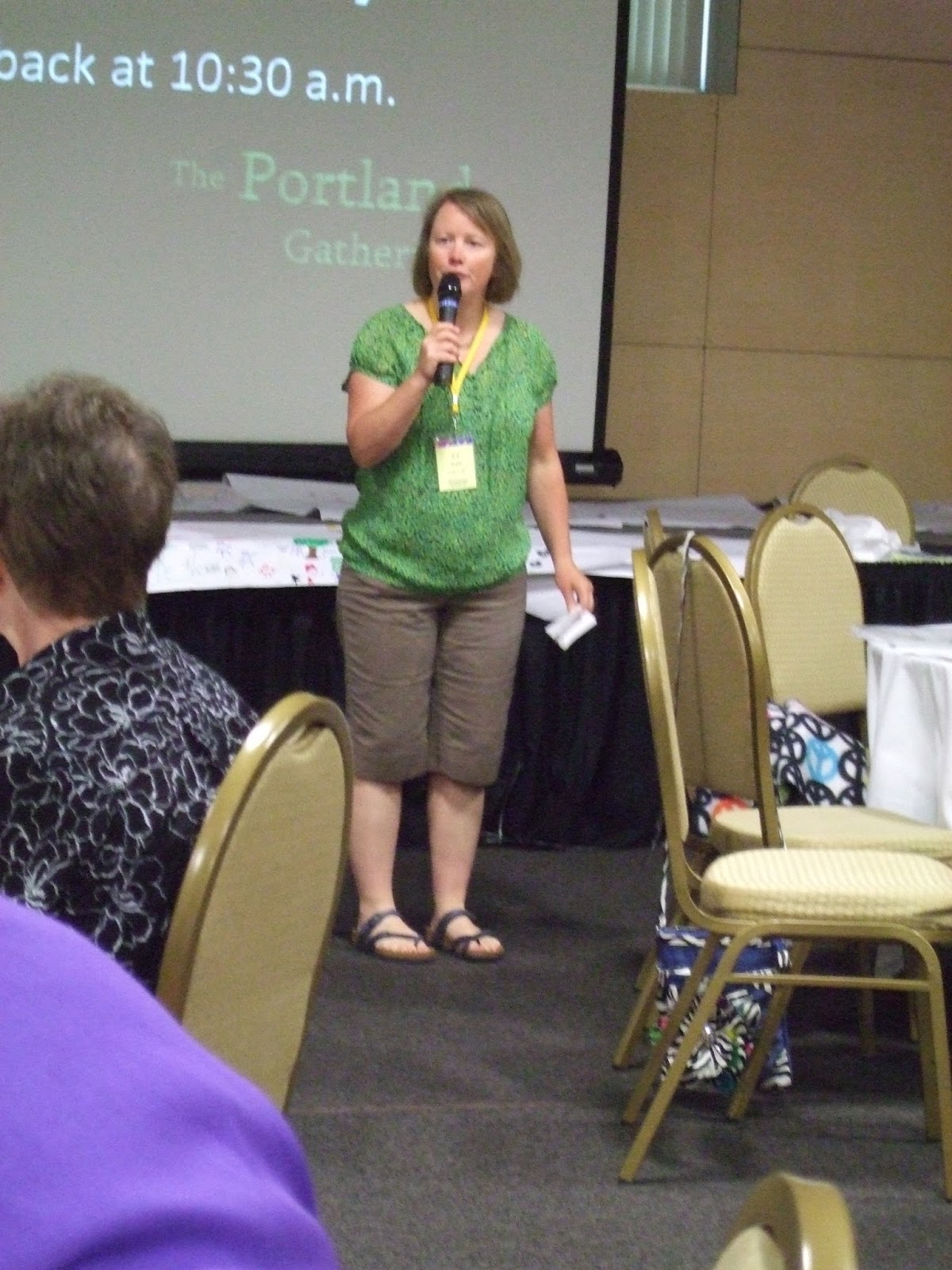
 Thursday's session of the Portland Gathering of The Learning community focussed on connecting with and building communities.

Michael Steinbruck challenging delegates to think
deeply about how they enable people to connect
We know this is a key problem for many people, with the rise of loneliness and social isolation affecting more and more people.

We discussed how Beth Mount is suggesting that the focus of our work needs to shift more toward community connecting, and Michael Steinbruck asked us to ponder the tools and strategies we've used that work to connect people.

Many strategies were discussed. The reality that the most simple approaches were the best: really being intentional about introducing and connecting people, in person, then allowing people to connect rather than getting in the way.

Tools like "from presence to contribution" and "what happens here" that help us think about how to support people to do more than just 'be present' in community settings, but actually participate, connect and contribute were discussed, and in my feedback I suggested looking into the '5 Ways to Wellbeing' (Staying Active, Connecting, Keep Learning, Taking Notice and Giving) as something that applies universally to how we can be in the community.

What was widely recognised as the most deeply instructive session of the morning was led by 'CJ' Webb of OTAC (Oregon Technical Assistance Corporation), the organisation that organised and hosted the Portland Gathering so brilliantly.

She gave us a very simple exercise: each table was given one or two words, with the instruction to go out into the community and find out about those words, without using the internet at all. The catch being we only had 30 minutes to do it in!

Our group had the words "Council Crest". Being a Brit, I assumed that this meant some kind of coat of arms that belonged to the local city council, so I began to study the parking meters and drain covers to try and find some insight, with no luck. My colleagues however found that a much more successful strategy was simply to stop passing people in the street and ask them what it meant to them.

We soon discovered it was a beautiful part of Portland, a mainly residential area overlooking the city with the most amazing view, and a very popular park. We found out detailed instructions of how to get there, and that it was also one of the best places in Portland to go to 'make out'.

Another groups found out the meanings of 'Stumptown', (Portland was originally surrounded by the stumps of trees, cut down to provide the wood to build it)

The group that was sent out to find out the meaning of 'Peach Melba' not only found out the story of it's invention, but sourced the ingredients in the community and made some from scratch to share in the session, all within the 30 minute deadline.

Another group had been busy seeking the meaning of the words 'Red Robin'. A homeless person became so intrigued by what they were doing that he went out of his way to help them. One of them told him "We walked past 4 homeless people before we talked to you". She felt this was deeply instructive about who we include and exclude from our concepts of 'community' when she shared this story with the rest of the Gathering.

The group that went out looking for the meaning of the word 'weird' was told "In Portland we think being normal is weird".

Kristi Patton's group found Mill Ends Park, the world's smallest park, which consists of one single small tree and a couple of rocks.

In the feedback about what they had learned about how we might contribute to community people said things like:

  • "We can be knowledgeable about our own communities so we can be brokers of information to our communities"
  • "Take the journey and risk learning something new, slow down and be more observant"
  • "Being present, helping others feel welcome and comfortable"
  • "Take time to plan, walk and look at what you've never seen before by walking"
  • "The community is a cornucopia of free opportunities" "Find out what is important to the community"
  • Laura Buckner tweeted "Don't forget people have virtual communities...FB, linkedIn, twitter etc....more connections!"

Overall, I found that over the 3 days I had had wonderful welcoming friendship from all the people at the gathering. At first I'd been noticing all the differences between Britain and the USA, but by the end I was realising there were far more similarities, that we share very much the same challenges and opportunities.

I realised that in our learning community, we've an international family of people who are speaking the same language of inclusion, connection and focus on what's important to the person.

I'll go home having learned a tremendous amount, with a load of questions to think about and a stomachful of inspiration. I can't wait to get back next year!