One person who made a major impression in my life was my friend Stuart, who I met at university in 1984.
Stuart was a committed socialist, so I spent lots of time with him organising the University Labour Club and the Miners' Support Group (Usually instead of studying).
Stuart had muscular dystrophy, used a wheelchair and drove his antiquated mini like a scalextric racing car, scaring the bejasus out of me.
It was Stuart who first introduced me to disability politics, by telling me Vic Finkelstein's story 'Revolution', which you can read in full here.
It's a remarkable story, in that it describes how well-meaning action can lead to exclusion and segregation, how in a society run by people with a particular impairment, it would be the people who did not share this impairment who would become 'disabled' by society itself: For example, in a society where everyone uses wheelchairs, why would they waste building materials on rooms with high ceilings? Then when someone comes along who belongs to the 2% that doesn't use a chair to get around, they find themselves having to stoop constantly, and wear a leather helmet to protect them from banging their head, they'd find it impossible to get work as workplaces would not be designed for their 'special needs', so would be forced into claiming benefits and seeking charity, even the clothes they bought in shops wouldn't fit properly, the ramifications are endless.
It's one of those stories that goes to the heart of issues of power and discrimination in society, when the environment and culture is structured in a way that ignores one section of society altogether.
Finkelstein's tale ends on a hopeful note, pointing toward the possibility of a society where people's different needs are met so they can each contribute their different gifts and get on together just fine.
What made me think about this story? The news today that Angela Bachiller has just been elected city councillor for the Spanish city of Valladolid. (The link I've shared is in Spanish, the English press don't yet seem to have picked up this story).
Angela will bring her experience of exclusion and discrimination as somebody with Down Syndrome to the City Council. She's already pointed out that many people with intellectual disabilities never even get the chance to vote.
How great that Valladolid will benefit from Angela's energy and commitment! There are plenty of people in our own communities who'd love a chance to share their energy, experience and commitment too, in their own way, if we had the imagination and will to create the kind of community where this can happen.
Showing posts with label community building. Show all posts
Showing posts with label community building. Show all posts
Monday, 5 August 2013

Saturday, 27 July 2013
Portland Gathering 2013 Thursday: Connecting with the Community
 |
| Ideas about inclusion and community living |
 |
| World Café Graphic |
Thursday's session of the Portland Gathering of The Learning community focussed on connecting with and building communities.
 |
| Michael Steinbruck challenging delegates to think deeply about how they enable people to connect |
We discussed how Beth Mount is suggesting that the focus of our work needs to shift more toward community connecting, and Michael Steinbruck asked us to ponder the tools and strategies we've used that work to connect people.
Many strategies were discussed. The reality that the most simple approaches were the best: really being intentional about introducing and connecting people, in person, then allowing people to connect rather than getting in the way.
Tools like "from presence to contribution" and "what happens here" that help us think about how to support people to do more than just 'be present' in community settings, but actually participate, connect and contribute were discussed, and in my feedback I suggested looking into the '5 Ways to Wellbeing' (Staying Active, Connecting, Keep Learning, Taking Notice and Giving) as something that applies universally to how we can be in the community.
What was widely recognised as the most deeply instructive session of the morning was led by 'CJ' Webb of OTAC (Oregon Technical Assistance Corporation), the organisation that organised and hosted the Portland Gathering so brilliantly.
She gave us a very simple exercise: each table was given one or two words, with the instruction to go out into the community and find out about those words, without using the internet at all. The catch being we only had 30 minutes to do it in!
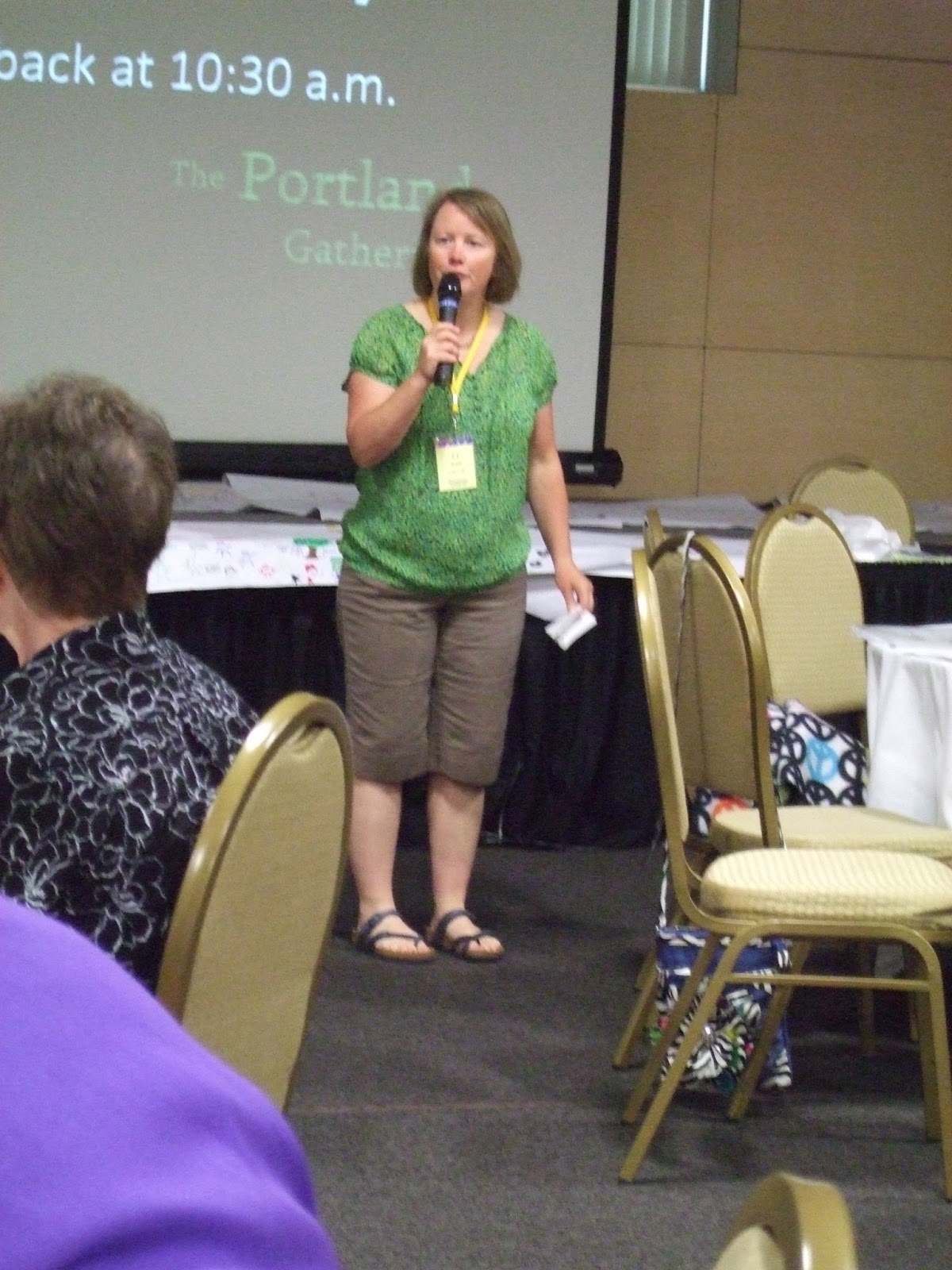
We soon discovered it was a beautiful part of Portland, a mainly residential area overlooking the city with the most amazing view, and a very popular park. We found out detailed instructions of how to get there, and that it was also one of the best places in Portland to go to 'make out'.
Another groups found out the meanings of 'Stumptown', (Portland was originally surrounded by the stumps of trees, cut down to provide the wood to build it)
The group that was sent out to find out the meaning of 'Peach Melba' not only found out the story of it's invention, but sourced the ingredients in the community and made some from scratch to share in the session, all within the 30 minute deadline.
Another group had been busy seeking the meaning of the words 'Red Robin'. A homeless person became so intrigued by what they were doing that he went out of his way to help them. One of them told him "We walked past 4 homeless people before we talked to you". She felt this was deeply instructive about who we include and exclude from our concepts of 'community' when she shared this story with the rest of the Gathering.
The group that went out looking for the meaning of the word 'weird' was told "In Portland we think being normal is weird".
Kristi Patton's group found Mill Ends Park, the world's smallest park, which consists of one single small tree and a couple of rocks.
In the feedback about what they had learned about how we might contribute to community people said things like:
- "We can be knowledgeable about our own communities so we can be brokers of information to our communities"
- "Take the journey and risk learning something new, slow down and be more observant"
- "Being present, helping others feel welcome and comfortable"
- "Take time to plan, walk and look at what you've never seen before by walking"
- "The community is a cornucopia of free opportunities" "Find out what is important to the community"
- Laura Buckner tweeted "Don't forget people have virtual communities...FB, linkedIn, twitter etc....more connections!"
Overall, I found that over the 3 days I had had wonderful welcoming friendship from all the people at the gathering. At first I'd been noticing all the differences between Britain and the USA, but by the end I was realising there were far more similarities, that we share very much the same challenges and opportunities.
I realised that in our learning community, we've an international family of people who are speaking the same language of inclusion, connection and focus on what's important to the person.
I'll go home having learned a tremendous amount, with a load of questions to think about and a stomachful of inspiration. I can't wait to get back next year!
Thursday, 28 February 2013
Eastleigh By Election
It just occurred to me, watching the Eastleigh by election results, that huge amounts of work goes on in a by-election, totally disproportionate to the result.
Thousands of doors are knocked on, hundreds of doorstep conversations.
As a consequence of all that work, one person gets a pretty well paid job. Then everyone goes away, and the streets are empty again. Even with all the politicians and journalists patrolling the streets, the food bank at Eastleigh ran out of food last week.
Imagine if all that work of canvassing and door knocking had been intentionally dedicated to linking up lonely and isolated people, building community groups and community resilience, actually solving a few community problems.
It might even make a by-election worth all the effort and expense.
Parliament has so little power these days that most people don't see much point in voting. In Italy they're even voting for comedians.
Political parties have lost their mass memberships and their connections with many local communities.
I think they need to turn themselves around 180 degrees, stop pointing themselves obsessively inward towards Westminster and start pointing back outward thinking about what they can do to actually serve the communities that elect them.
Maybe by-elections should be turned upside down. Instead of getting one person from a community into power, they could be about getting power back to people in the community...
Thousands of doors are knocked on, hundreds of doorstep conversations.
As a consequence of all that work, one person gets a pretty well paid job. Then everyone goes away, and the streets are empty again. Even with all the politicians and journalists patrolling the streets, the food bank at Eastleigh ran out of food last week.
 |
| What's left behind when all the press and politicians go back to Westminster? |
Imagine if all that work of canvassing and door knocking had been intentionally dedicated to linking up lonely and isolated people, building community groups and community resilience, actually solving a few community problems.
It might even make a by-election worth all the effort and expense.
Parliament has so little power these days that most people don't see much point in voting. In Italy they're even voting for comedians.
Political parties have lost their mass memberships and their connections with many local communities.
I think they need to turn themselves around 180 degrees, stop pointing themselves obsessively inward towards Westminster and start pointing back outward thinking about what they can do to actually serve the communities that elect them.
Maybe by-elections should be turned upside down. Instead of getting one person from a community into power, they could be about getting power back to people in the community...
Sunday, 10 February 2013
Living With Open Hands
Every so often I'm going to use this space to highlight a blog that I think has something special about it.
The first blog I've chosen to share is 'Living With Open Hands', a blog by Ron Irvine.
 The reason I've chosen this blog is because every single post contains something that forces you to think. Ron chooses to live under the rising, rather than the setting sun, and therefore he sees possibilities where others see problems, sees human capacities where others see deficits, sees people as mysteries to be explored where others see problems to be cured.
Some recent posts I'd like to point you toward are: Being Human; A Profound Paradox I don't know whether you could call it a religious post, but it is a deeply spiritual one, challenging us to explore who we are, and who the people are around us.
Ron's post A Meaningful Life contains resources that help us name and claim our own gifts, then use them to contribute to the others around us. It contains a chart on capacity thinking that I try to look at as often as I can:

The first blog I've chosen to share is 'Living With Open Hands', a blog by Ron Irvine.
 The reason I've chosen this blog is because every single post contains something that forces you to think. Ron chooses to live under the rising, rather than the setting sun, and therefore he sees possibilities where others see problems, sees human capacities where others see deficits, sees people as mysteries to be explored where others see problems to be cured.
Some recent posts I'd like to point you toward are: Being Human; A Profound Paradox I don't know whether you could call it a religious post, but it is a deeply spiritual one, challenging us to explore who we are, and who the people are around us.
Ron's post A Meaningful Life contains resources that help us name and claim our own gifts, then use them to contribute to the others around us. It contains a chart on capacity thinking that I try to look at as often as I can:

The place to take and share our gifts is the community. Ron has collected together a wealth of thinking and resources around community building, including a whole set of videos of John McKnight explaining his ideas: On Community
His thoughts on how we marginalise other humans are also very powerful. The question of marginalisation, how we separate ourselves and our species, how we weaken and divide ourselves by excluding 'the other' is one of the questions we need to answer. Ron stands on the side of the marginalised, downtrodden, excluded, invisible, forgotten, despised, reviled and paradoxically gains his strength from this. We have unbalanced our society, and it must sooner or later come back into balance.
Overall I think Ron's message is that any work we begin, begins with ourselves. We need to begin every change we wish to see in the world by trying to create it internally, and on our own doorstep. I don't think this however leads to self-indulgent introspection. Ron's thought is intensely practical and focussed on real people and real world issues. For Ron, doing arises out of being. So what we do and what we are must reflect each other.
Once you've found Living With Open Hands, you will wait with great anticipation for every next post.
I won't speculate on why Ron writes. Luckily I don't need to. He explains why in his post The Sacred and the Boundless:
For me, writing has become a way for me to find my voiceBecause thinking begins with a question, and ends with an answer, we need more writers like Ron who ask questions that never quite get answered, so that we're always driven to keep thinking and exploring.
and to give voice to my questions;
a journey
from dogmatism and certainty to inquiry and dialogue,
from living with clenched fists to living with open hands.
Saturday, 9 February 2013
Local Food Justice
My last post on the UK Horsemeat scandal and the need for local communities to regain control over those fundamental aspects of our lives, like our food, how we support each other, how we live prompted a reply from John O'Brien, which from my perspective is about as incredible as Shakespeare leaving a comment on a blogpost by Jeffrey Archer, with or without those certain logistical issues.
I noticed that the link he posted hasn't been activated by blogger, so I'm reposting it here so that you can click straight through onto the video he recommends. Well worth a watch!
I noticed that the link he posted hasn't been activated by blogger, so I'm reposting it here so that you can click straight through onto the video he recommends. Well worth a watch!
Food Fight
Something's been building up inside me as the scandal around adulterated Tesco burgers, contaminated Findus Lasagne and the fact that the multinational food industry has been feeding us horsemeat in the guise of beef, at least since August on a fairly massive scale.
.
Behind the scenes, but across the country, in community after community, things have been happening that I'm only just realising were the beginnings of a groping toward an unconscious defence against just such eventuality.
Because for the last year or so, in response to growing need and hardship, communities have been setting up food banks, to make sure their hardest pressed members got fed. Volunteers have been collecting from neighbours, and recycling food that might otherwise have been dumped.
This has been coupled with ideas like 'slow food' and 'grow it local', where land owned by the council the NHS, or just standing idle has been reclaimed by the community for 'Community Food Growing Initiatives'.
 |
| Would you like to know how many times you've been eating this? |
What these developments suggest to me that we're intrinsically sensing, is that food has just got out of our control. Whether it's pink chicken mush, burgers and buns that simply never look mouldy, factory farmed, antibiotic stuffed stressed animals, we really don't like to even think about it, but for many it's all that's available to us.
We're thinking that if communities win back control over the food we eat, we can eat something that we actually know where it came from, how fresh it is, what chemicals it contains.
And communities need to win back control over other parts of the 21st Century that are going wrong too. All those people who may exist in the same geographical space, but are trapped without any contact with the community around them, little hermetically sealed units where they may or may not get the occasional visit from a health or social care agency, but where for years the person's actual neighbours have not felt confident to tread. We need to break down those invisible walls that are dividing our communities.
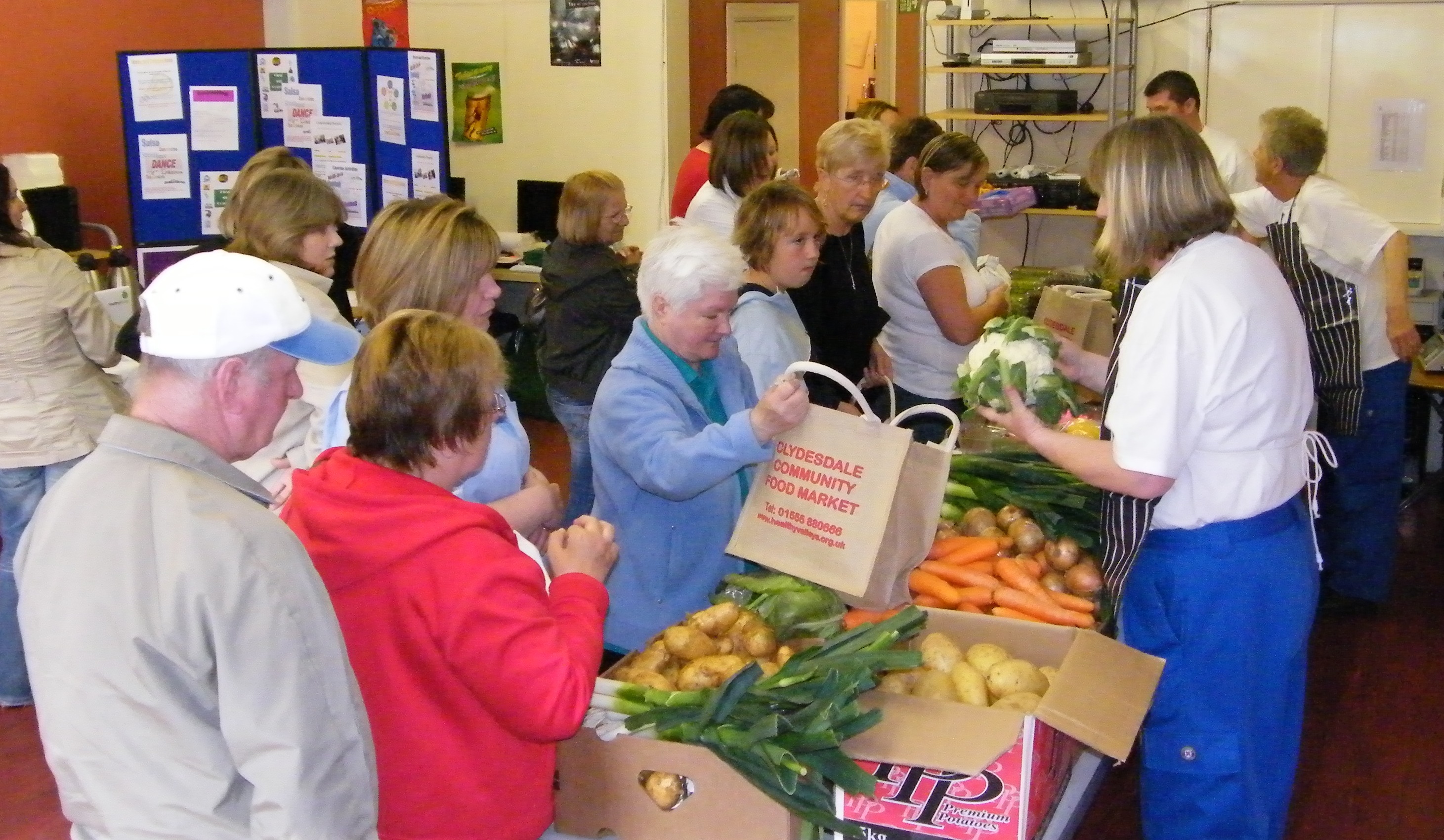 |
| Clydesdale Community Food Market |
In all our communities, we need to win back control over our food, our health, our care for ourselves and each other.
Cormac Russell recently spoke to the people at 'Occupy Wall St'. He said to them: "When you've finished occupying here, I hope you go back and occupy your own communities. That's where the hearts are being ripped out of you, that's where the process begins that ends in Wall St. The movement for change can only start on your own doorsteps"
While our superstores are feeding us horsemeat, our communities are building alternatives. Today we're struggling to win back control over the very stuff of life - our food, our relationships, our lives. We're choosing to do it in community.
I got the images for this post from: http://www.communityfoodandhealth.org.uk/community-based-activity/case-studies/clydesdale-community-food-market/clydesdale-community-food-market-2/
and http://sherific.blogspot.co.uk/2011/02/fast-food.html
Thursday, 24 January 2013
Loneliness and Social Isolation
Recently Homa Khaleeli wrote very touchingly in the Guardian about "Britain's Loneliness Epidemic".
She pointed out how increasing numbers of people are feeling lonely, and that loneliness should be considered an indicator for society's health.
As this tide of loneliness increases, people are beginning to discover some of what David Pitonyak pointed out in 'Loneliness is the only real disability': In the absence of real, freely chosen relationships in people's lives, any benefits of health and social care interventions simply cannot be maintained.
Loneliness has huge effects on people's health, and has huge costs to the NHS through increased rates of stress, cancer, stroke, dementia and heart disease that manifest among the lonely. Loneliness has a direct physical effect on the body, as well as affecting people's mental health. Lonely disconnected people are also less likely to get the best care from health and social care services, they have noone to advocate for them, noone to question and challenge, noone to boost their confidence to ask difficult questions.
Lonely disconnected people are also far more likely to become victims of abuse, both in the community and in care services. Their lack of social connection makes them vulnerable to hate crime and 'mate crime'. Social isolation and exclusion happens in rural communities, and in the middle of the city.
It's also clear that people are far more likely to feel lonely if they are elderly or disabled, or excluded from society because they belong to another oppressed, discriminated or excluded group.
Loneliness is therefore something that not only exists in every street in every town, it is something both health and social care services meet commonly in their everyday work, so often in fact that we stop even seeing it.
People who work in health services report people who repeatedly turn up at their GP with a new set of symptoms every week, people who fear the loss of community nursing services so much that they will deliberately exacerbate the symptoms they are receiving treatment for. These people often don't get much sympathy, they're called 'heartsink' patients, or branded as 'manipulators' and 'attention seeking'. Yet these are the desperate measures people will go to to alleviate their loneliness, a sign of how deeply their loneliness is causing them pain.
Yet the frustrating thing is that while these services may address the person's immediate diagnosed condition, thinking about how to address the person's social isolation is rare, in fact the way these services work often reinforces such isolation, in countless subtle and not so subtle ways. How much time thought and energy is actually spent in each social care service and with each person thinking about how to help people build relationships or to reconnect with their community?
I used to visit a building regularly. You would walk up a long path beside a building with boarded up windows that had been painted black, it looked like a deserted rotting wooden shell. Once you turned the corner, a 7ft high grey metal fence would meet you. On the gate in that fence was a sign. It read "social inclusion service". If they had tried to design a building to make it's occupants and visitors feel less socially included, I don't think they could have succeeded.
In Britain, social exclusion begins early in the lives of disabled people. Most people build their first connections at school, and by playing with their school friends after school and at weekends. Disabled people often get sent to different schools, often necessitating long travelling times. Opportunities to play outside in the evening are limited. Then what connections they have built up in local communities are torn away for 2 years while they attend 'residential colleges'. When they come back the work of rebuilding those connections can seem daunting.
In discussing loneliness, I've found some people like to divide it into two areas: loneliness; meaning the feeling of loneliness, and 'social isolation'; meaning the structural issues that prevent people from forming meaningful relationships.
I can see the precise academic logic behind this distinction, but I'm not sure whether in practice, the distinction is that useful, and I'm worried that it may even hold us back.
We tend to understand how to deal with loneliness in our own lives and in our own families and friends. If we got together in groups and thought about practical ways to help a person overcome loneliness, we could come up with quite a list.
So many of us are deeply experienced in forming and maintaining relationships, and understand the joys and pitfalls they can bring. It is exactly these experiences we need to tap when we think about how to enable more people to form relationships and have better lives in the community.
But do the same exercise with 'social isolation' and we're likely to be stumped, or just come up with a list full of empty jargon words that contain no practical way forward (basically the same thing).
When loneliness becomes 'social isolation' it sounds far too big and complex to do anything about. Something for the 'experts' to deal with. I also wonder whether loneliness is something 'we' are allowed to feel from time to time, but 'social isolation' is something that only happens to 'them' disabled and elderly people, the 'service users', a jargon word conveniently consigning thinking about that issue and action to resolve it to comfortably outside our own sphere of influence.
Of course we need to take action against the barriers that create loneliness at different levels. The personal level, the community level and the societal level. At each level we need to ask "are we making changes that help people form and maintain lasting and meaningful relationships, or is what we're doing preventing that?"
At a personal level, time spent thinking about a person's relationship circle and how to build it, thinking about using community connecting tools, action to build a circle of support, getting out there and creating opportunities to interact that make sense to the person, that reflect what's important to them, could all be valuable ways forward. Bob Perske has some great thoughts on this.
So what are we doing to resist all this? What alternative forums for people to meet, talk, think and act together are springing up? Can we assist this? Can we create our own and bring people in? In America communities face very similar questions, and have developed what they're calling 'Asset Based' approaches. This work has led to developments like 'Local Area Coordination' and its 10 principles. The first, and key principle is:
(Quote from http://inclusiveneighbourhoods.co.uk/)
At a social level we need to start questioning the values and assumptions that are excluding people. Are we thinking too much about institutions, empires, interest rates, and not enough about actual people? Do our leaders consider how national policies might impact on the way people get to meet and spend time with each other?
 Gay people don't have 'gay marriages' they have marriages. Disabled people don't in general have 'disabled relationships', they have relationships. Actions and strategies that enable more disabled, chronically sick and elderly people form more meaningful relationships are also likely to enable everybody to form more meaningful relationships.
Personal Budgets add a new layer of complexity to relationships, they enable an employer/employee relationship, which can get complicated when PA's are also people's friends or family. It will be interesting to see how PA's are used by disabled people in opening up their social lives.
Turning the rising tide of loneliness is a great task for the 21st Century. Building warm accepting inclusive communities is everyone's responsibility, and will lead to better lives for everybody.
If the disease is loneliness, then we are all the cure.
Thanks to 'The Abundant Community' for the image of 44 ways to build community
 |
| Are we building a culture based on disconnection? What can we do about this? |
As this tide of loneliness increases, people are beginning to discover some of what David Pitonyak pointed out in 'Loneliness is the only real disability': In the absence of real, freely chosen relationships in people's lives, any benefits of health and social care interventions simply cannot be maintained.
Loneliness has huge effects on people's health, and has huge costs to the NHS through increased rates of stress, cancer, stroke, dementia and heart disease that manifest among the lonely. Loneliness has a direct physical effect on the body, as well as affecting people's mental health. Lonely disconnected people are also less likely to get the best care from health and social care services, they have noone to advocate for them, noone to question and challenge, noone to boost their confidence to ask difficult questions.
Lonely disconnected people are also far more likely to become victims of abuse, both in the community and in care services. Their lack of social connection makes them vulnerable to hate crime and 'mate crime'. Social isolation and exclusion happens in rural communities, and in the middle of the city.
It's also clear that people are far more likely to feel lonely if they are elderly or disabled, or excluded from society because they belong to another oppressed, discriminated or excluded group.
Loneliness is therefore something that not only exists in every street in every town, it is something both health and social care services meet commonly in their everyday work, so often in fact that we stop even seeing it.
People who work in health services report people who repeatedly turn up at their GP with a new set of symptoms every week, people who fear the loss of community nursing services so much that they will deliberately exacerbate the symptoms they are receiving treatment for. These people often don't get much sympathy, they're called 'heartsink' patients, or branded as 'manipulators' and 'attention seeking'. Yet these are the desperate measures people will go to to alleviate their loneliness, a sign of how deeply their loneliness is causing them pain.
Yet the frustrating thing is that while these services may address the person's immediate diagnosed condition, thinking about how to address the person's social isolation is rare, in fact the way these services work often reinforces such isolation, in countless subtle and not so subtle ways. How much time thought and energy is actually spent in each social care service and with each person thinking about how to help people build relationships or to reconnect with their community?
I used to visit a building regularly. You would walk up a long path beside a building with boarded up windows that had been painted black, it looked like a deserted rotting wooden shell. Once you turned the corner, a 7ft high grey metal fence would meet you. On the gate in that fence was a sign. It read "social inclusion service". If they had tried to design a building to make it's occupants and visitors feel less socially included, I don't think they could have succeeded.
In Britain, social exclusion begins early in the lives of disabled people. Most people build their first connections at school, and by playing with their school friends after school and at weekends. Disabled people often get sent to different schools, often necessitating long travelling times. Opportunities to play outside in the evening are limited. Then what connections they have built up in local communities are torn away for 2 years while they attend 'residential colleges'. When they come back the work of rebuilding those connections can seem daunting.
In discussing loneliness, I've found some people like to divide it into two areas: loneliness; meaning the feeling of loneliness, and 'social isolation'; meaning the structural issues that prevent people from forming meaningful relationships.
I can see the precise academic logic behind this distinction, but I'm not sure whether in practice, the distinction is that useful, and I'm worried that it may even hold us back.
We tend to understand how to deal with loneliness in our own lives and in our own families and friends. If we got together in groups and thought about practical ways to help a person overcome loneliness, we could come up with quite a list.
So many of us are deeply experienced in forming and maintaining relationships, and understand the joys and pitfalls they can bring. It is exactly these experiences we need to tap when we think about how to enable more people to form relationships and have better lives in the community.
But do the same exercise with 'social isolation' and we're likely to be stumped, or just come up with a list full of empty jargon words that contain no practical way forward (basically the same thing).
When loneliness becomes 'social isolation' it sounds far too big and complex to do anything about. Something for the 'experts' to deal with. I also wonder whether loneliness is something 'we' are allowed to feel from time to time, but 'social isolation' is something that only happens to 'them' disabled and elderly people, the 'service users', a jargon word conveniently consigning thinking about that issue and action to resolve it to comfortably outside our own sphere of influence.
Of course we need to take action against the barriers that create loneliness at different levels. The personal level, the community level and the societal level. At each level we need to ask "are we making changes that help people form and maintain lasting and meaningful relationships, or is what we're doing preventing that?"
At a personal level, time spent thinking about a person's relationship circle and how to build it, thinking about using community connecting tools, action to build a circle of support, getting out there and creating opportunities to interact that make sense to the person, that reflect what's important to them, could all be valuable ways forward. Bob Perske has some great thoughts on this.
 |
| Ideas about building communities |
At the level of organisations and communities, we need to rethink attitudes to risk, the architecture and furniture of buildings, the ways and opportunities our systems and structures offer opportunities to connect, whether staff understand their own role as 'community connectors', seeing connecting people as part of their individual and organisational purpose, seeing people's relationships as something to value and cherish and accepting that this can include loving sexual relationships.
At a community level the number of places people can meet and socialise is diminishing. Local pubs are closing, post offices, local shops, community centres, libraries. Shopping centres in decline as people stay at home and buy over the internet. The list goes on.
In my area new estates are springing up, where they don't even have pavements. People who move in there are thus actively being discouraged from going out of their front door, walking around the neighbourhood, and perhaps meeting their neighbours!
People are being encouraged to work from home - missing out on what the Americans call 'water cooler moments' the informal networking that makes organisations work better and employment a method of building relationships.
In my area new estates are springing up, where they don't even have pavements. People who move in there are thus actively being discouraged from going out of their front door, walking around the neighbourhood, and perhaps meeting their neighbours!
People are being encouraged to work from home - missing out on what the Americans call 'water cooler moments' the informal networking that makes organisations work better and employment a method of building relationships.
"As citizens, people vulnerable due to age, disabilities or mental health needs have the same rights and responsibilities as all other people to participate in and contribute to the life of the community."
(Quote from http://inclusiveneighbourhoods.co.uk/)
At a social level we need to start questioning the values and assumptions that are excluding people. Are we thinking too much about institutions, empires, interest rates, and not enough about actual people? Do our leaders consider how national policies might impact on the way people get to meet and spend time with each other?
 Gay people don't have 'gay marriages' they have marriages. Disabled people don't in general have 'disabled relationships', they have relationships. Actions and strategies that enable more disabled, chronically sick and elderly people form more meaningful relationships are also likely to enable everybody to form more meaningful relationships.
Personal Budgets add a new layer of complexity to relationships, they enable an employer/employee relationship, which can get complicated when PA's are also people's friends or family. It will be interesting to see how PA's are used by disabled people in opening up their social lives.
Turning the rising tide of loneliness is a great task for the 21st Century. Building warm accepting inclusive communities is everyone's responsibility, and will lead to better lives for everybody.
If the disease is loneliness, then we are all the cure.
"Loneliness is taking a toll on our individual, collective and societal health, and those health consequences carry a heavy economic burden. Just as lonely feelings are nature’s way of telling us to seek out company, the problem of loneliness in society is a prompt to revitalise our communities, and better integrate their members."
Mental Health Foundation: The Lonely Society?
If you're reading this because you feel very lonely yourself, here's some advice from MIND on how to cope with loneliness.
Thanks to 'The Abundant Community' for the image of 44 ways to build community
Subscribe to:
Posts (Atom)